The “Industry Leader”

Why Your 2026 Strategy Must Be "Agent-First"

The digital marketing industry just had its "Oppenheimer moment." For two decades, we played a relatively simple game: create content, rank on Page 1, and capture the click. We obsessed over keywords, backlink profiles, and the "10 blue links" that Google served us. But as we navigate 2026, that game hasn't just changed—the board has been flipped over and the pieces have been melted down. We have officially entered the Post-Search Era. Today, the majority of top-of-funnel research isn't being done by a human scrolling through a list of websites. It’s being executed by AI Agents. Whether it’s a user’s personal digital twin, a specialized research bot, or a generative answer engine like Gemini or Perplexity, the "user" at the front of your marketing funnel is no longer a person—it’s a machine. If your 2026 strategy is still optimized solely for human clicks, you are becoming invisible to the very systems that drive modern commerce. We are moving away from Search Engine Optimization (SEO) and into the high-stakes world of Generative Engine Optimization (GEO). In this new landscape, winning isn't about being "found"; it’s about being cited, trusted, and synthesized by the algorithms that now act as the world's gatekeepers. The "Golden Age of the Click" is over. Welcome to the era of Agentic Marketing. This is your modular playbook for surviving the shift—from mastering the "Inference" of AI models to building a human moat that no bot can replicate.

The Death of the Click and the Rise of "Inference"

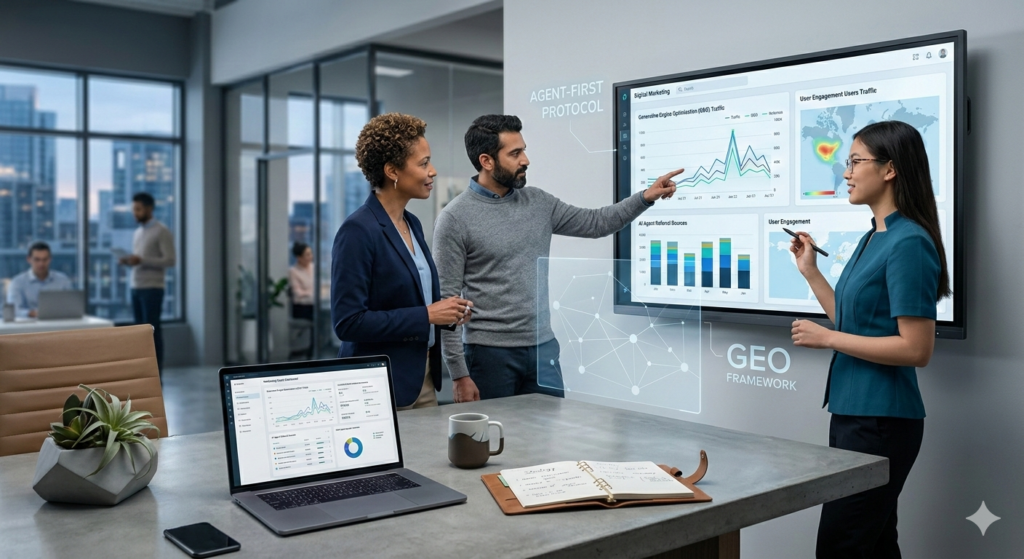
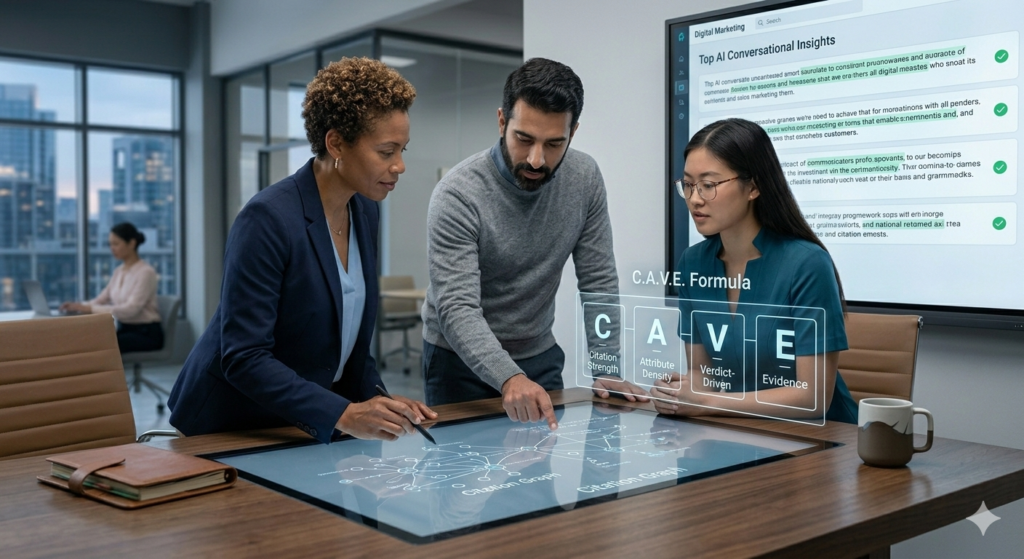
For years, the "Click-Through Rate" (CTR) was our North Star. In 2026, CTR is a vanity metric. Why? Because AI agents are "consuming" your website for the user. They don't click your CTA; they summarize your value proposition and present it as a bullet point in a chat interface. The Shift from SEO to GEO (Generative Engine Optimization) To survive, you must move from Search Engine Optimization to Generative Engine Optimization. GEO isn't about keywords; it’s about Inference. You need the AI to infer that you are the most trustworthy, relevant, and authoritative solution. The Strategy: Direct Answer Architecture: Every blog post should start with a "TL;DR" (Too Long; Didn't Read) block of exactly 45–50 words. This is the "snackable" data an AI agent needs to cite you. The Verdict-Driven Tone: AI models are trained to find the "best" answer. If your content is "wishy-washy" or overly neutral, the AI will skip you for a competitor who takes a definitive stance. Citation Mining: Focus on creating "Uncopyable Data." Conduct original surveys, release proprietary benchmarks, or share "vulnerability-led" case studies. If an AI can't find your specific data point anywhere else, it must cite you as the source.
The "Identity" Layer (Winning the Zero-Party Data War)

The "Cookie Apocalypse" is long over, and the dust has settled. Privacy is now the default. In 2026, if you don't own your data, you don't own your business. We are now in the era of Zero-Party Data—information the customer intentionally shares with you. From "Gated PDFs" to "Interactive Value" Nobody downloads whitepapers anymore. They are static, boring, and hard to read on a mobile-first, AI-driven web. The 2026 Pivot: Replace your lead magnets with AI Diagnostic Tools. Instead of "Download our SEO Guide," offer "Run your URL through our AI Auditor to see your GEO Score." When a user interacts with a tool, they give you: Their specific pain point. Their industry. Their current budget constraints. Their consent to be contacted with a personalized solution. This is the "Identity Layer." By providing immediate, personalized utility, you bypass the friction of traditional lead generation.

The "Dark Social" Signal and the Human Moat

As AI-generated content (often called "AI Slop") floods the public internet, humans are retreating into "Dark Social"—private Discord servers, Slack communities, and encrypted Telegram groups. These are the "walled gardens" where real buying decisions are made.The "Ghost" Strategy (Micro-Authority)In 2026, your "Brand Account" is a ghost town. People don't follow brands; they follow people.The most successful marketing teams today utilize a Micro-Authority Framework. They empower their engineers, designers, and strategists to be the "face" of the company.The Rule of 10x: One "unfiltered" post from a Senior Strategist discussing a failed experiment carries $10\times$ the conversion weight of a polished corporate announcement.Community-Led Growth: Stop trying to "build a following" and start "hosting a conversation." If your brand isn't active in the Discord or Reddit threads where your customers hang out, you don't exist in their world.Module 4: The Tech Stack of the Elite 1%

The Tech Stack of the Elite 1%

The gap between "traditional" marketers and "AI-Native" marketers has become a canyon. In 2026, the elite stack looks fundamentally different. It’s no longer about a suite of 20 different tools; it’s about interconnected AI agents.Marketing FunctionThe "Old" Way (2024)The "Agentic" Way (2026)Content ProductionHuman writer + AI assistantMulti-Agent Swarms: One AI researches, one drafts, one fact-checks, and one optimizes for GEO.Ad ManagementA/B testing headlinesReal-Time Generative Creative: Ads that morph their imagery and copy based on the viewer's live sentiment.Customer SupportFlow-chart ChatbotsEmpathetic AI Agents: Bots that can negotiate discounts, solve complex tech issues, and upsell based on history.AnalyticsLooking at what happened (GA4)Predictive Intelligence: AI that tells you who will churn in 30 days and what offer will stop them.

Hyper-Dynamic Personalization (The UX Revolution)

The "Static Website" is a relic. In 2026, a visitor from a Fortune 500 company should see a completely different landing page than a visitor from a boutique startup—even if they click the same link. Dynamic UI/UX: Using real-time IP enrichment and AI, your website should rewrite its headers, swap its testimonials to match the visitor’s industry, and adjust its pricing modules in milliseconds. Quote from the Field: "If your website feels the same to every visitor, you're treating your customers like a demographic, not a person. In 2026, that's the fastest way to lose a lead."

Ethics, Empathy, and the "Human Moat

With all this talk of agents and automation, you might think humans are obsolete. The opposite is true. Because AI can now do "average" work at zero cost, average is now worthless. Your "Human Moat" is the only thing AI cannot replicate: Empathy, Intuition, and Taste. Empathy: Understanding the unspoken fear a client has about their industry. Intuition: Knowing when to pivot a strategy because of a cultural shift that hasn't hit the data sets yet. Taste: The ability to curate aesthetics and brand voice so they feel "alive" rather than "calculated."

The 2026 Manifesto

The "Post-Search Protocol" isn't about abandoning the old ways—it’s about transcending them. Optimize for the Agent: Be the source of truth that AI engines crave. Own the Data: Trade high-value utility for deep identity insights. Go Dark: Invest in human-to-human communities where AI can't follow. Automate the Logic, Manualize the Magic: Let agents handle the data, but keep a human hand on the "vibe" and strategy. The internet of 2026 is faster, smarter, and more crowded than ever. Don't just add to the noise. Be the signal.

Leave a Reply

Your email address will not be published. Required fields are marked *